
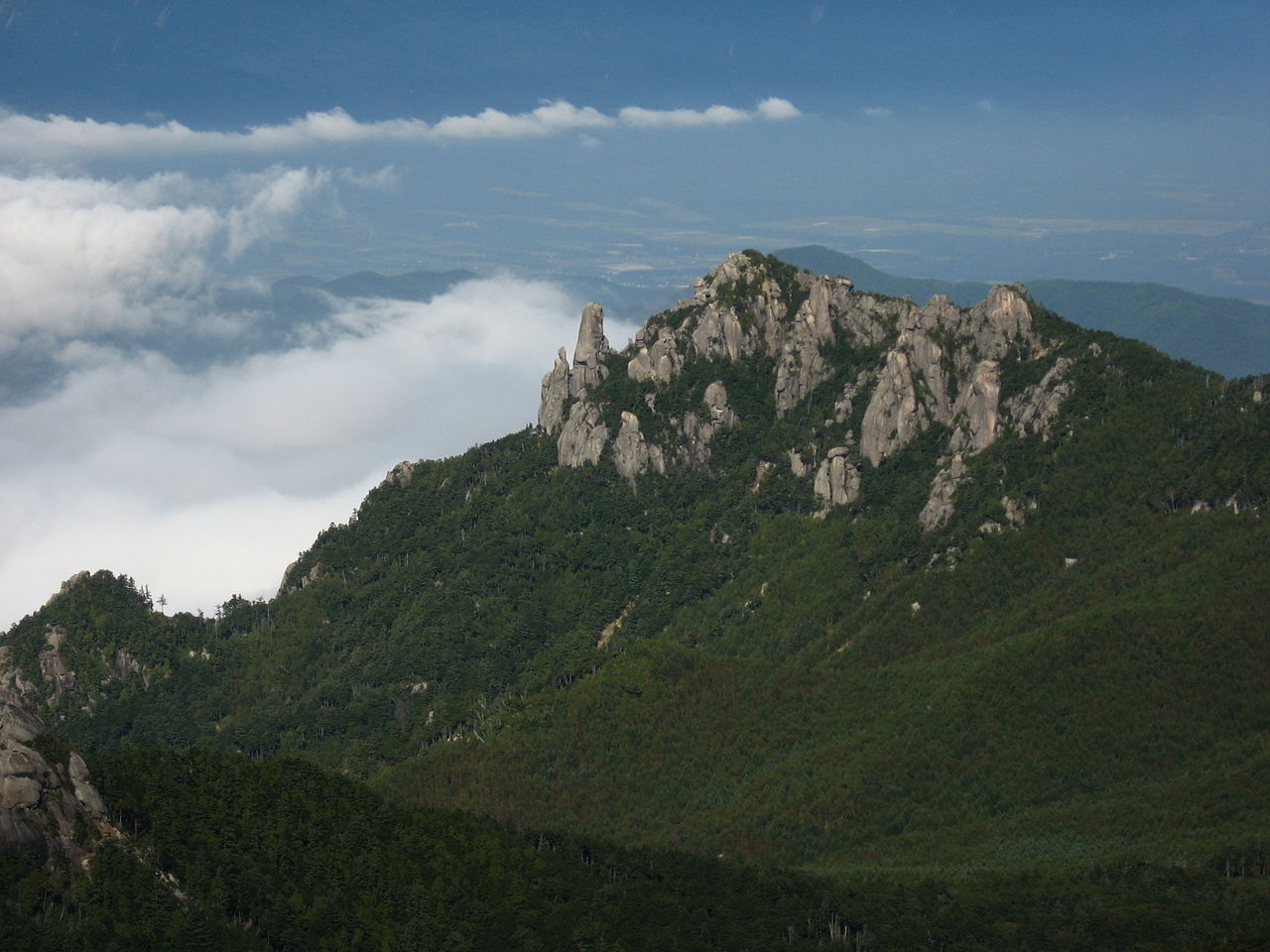
A forest of granite pillars in the Oku-Chichibu
Mt. Mizugaki rises 2,230 m (7,316 ft) in Hokuto, Yamanashi — a granite peak in the heart of the Chichibu-Tama-Kai National Park. It is paired with Mt. Kinpu as one of the principal western Oku-Chichibu peaks. Kyūya Fukada wrote about Mizugaki in Nihon Hyakumeizan specifically for the forest of granite rock pillars on its summit zone. 'Mizugaki' originally meant 'sacred fence' — an old word for the boundary of a divine precinct — and the name reportedly comes from the way the rock towers stand like a fence enclosing the summit.
What distinguishes Mizugaki from the rest of the Oku-Chichibu is that the granite body of the mountain has been carved over time into dozens of vertical rock pillars and walls clustered around the summit. Named features — Ō-Yasuri, Momotarō-iwa, Jūichimen-iwa, Fudō-iwa — appear one after another, and climbers thread their way to the summit through corridors between the pillars. Few 2,000 m-class peaks in Japan show granite-pillar geomorphology this pronounced, and Mizugaki stands as a rare mountain where the rock itself is the centrepiece of the scenery.
From Mizugaki Sansō, through the rock-tower corridors
Mizugaki essentially has one route. From Mizugaki Sansō (1,520 m), the trail climbs past Fuji-mi-daira hut, crosses the Amadori-gawa stream, passes Momotarō-iwa, and works around the base of Ō-Yasuri-iwa to the summit. About 710 m of vertical, 3 hours up and 2.5 down, 5–6 hours total. The route day-trips easily and is one of the more pedestrian-friendly summit attacks in the Oku-Chichibu.
The route is rich in mid-trail sights. Before Fuji-mi-daira a plaza offers a Fuji view; side trails reach Fudō Falls; Momotarō-iwa is a famous boulder split to look like a peach; and Ō-Yasuri-iwa, a roughly 100 m vertical granite wall just below the summit, is the visual centrepiece. Ō-Yasuri-iwa is also the symbolic crag of Mizugaki rock climbing and has been climbed as a route objective for decades. Hikers skirt the base and reach the summit plateau via a chain section.
The standard plan is a Mizugaki Sansō day-trip. Strong climbers do the two-day Mizugaki + Kinpu pairing, sleeping at Fuji-mi-daira on night one and summiting Kinpu on day two, or descending from Kinpu Sansō over Mizugaki. The Mizugaki + Kinpu two-day traverse is the classic Oku-Chichibu pairing.
Rock climbing capital: Jūichimen-iwa and Ō-Yasuri-iwa
Mizugaki cannot be described without its standing as a rock-climbing destination. The granite pillars around the summit are one of Japan's principal crack-climbing grounds and have driven the development of post-war Japanese free and sport climbing. Jūichimen-iwa, Ō-Yasuri-iwa, Kanmanboron, Fudō-sawa, and others hold hundreds of established routes.
Regular climbers won't be on those walls, but along the hiking trail you regularly see climbers on the lower or mid-sections. Mizugaki is a mountain shared by hikers and rock climbers — a different mountain culture from the rock ridges of the Northern Alps, where the rock is itself the goal. Climbing Mizugaki is at once threading the tower corridors and stepping into one of the centres of Japanese rock-climbing culture.
Mizugaki Sansō and Fuji-mi-daira hut: the two huts
Mizugaki has two huts. Mizugaki Sansō at the trailhead (1,520 m) runs year-round as a pre- and post-climb base. The building is modern and well-maintained, and many climbers fold an overnight here into the trip. Fuji-mi-daira hut at 1,810 m sits at the junction between Mizugaki and Kinpu, serving as the overnight for either or both peaks. A Mizugaki day-trip needs neither, but the Mizugaki + Kinpu traverse routinely uses Fuji-mi-daira.
Peak-season reservations are advisable weeks in advance. Mizugaki's hut network is comparatively simple by Oku-Chichibu standards because the climb is day-trippable. Trip planning is essentially the three-option choice: 'Mizugaki only,' 'Mizugaki + Kinpu,' or 'long-day Kinpu from Mizugaki Sansō'.
Year-round climbing — season and gear
Mizugaki's snow-free season runs roughly April through November. Because Mizugaki Sansō runs year-round it can be climbed in winter too, but the chain section below the summit becomes icy and snowy, and light crampons plus winter gear become mandatory. Climbers visit from spring through autumn, making Mizugaki one of the rare Oku-Chichibu peaks with year-round foot traffic. May Aka-yashio, summer hiking, October colour, November bare-winter — each season has a different presentation.
Gear assumes a 2,200 m rock-ridge crossing. Fleece and a wind- and waterproof shell are not optional; mid-cut or higher boots for the rock-zone grip; a 20 L pack for a day-trip. A helmet is recommended for the chain section and summit rock zone, and rain makes the rock noticeably more slippery — exercise extra caution. Winter ascents require light crampons, a real winter shell, and spare insulation.
From Mizugaki's summit, the classic photograph frames Mt. Kinpu and the Gojō-iwa spire against the foreground granite pillars. The summit view runs northeast to Kinpu, east across the Oku-Chichibu ridge, south to Mt. Fuji, west to the Yatsugatake and Southern Alps, north to the upper Jōshin'etsu ranges. An overnight at Fuji-mi-daira followed by a pre-dawn summit climb catches the first morning light turning the granite towers gold. New-moon midsummer nights give a real Milky Way over the rock forest.
Nirasaki Station and Mizugaki Sansō — access
Access runs from Nirasaki Station on the JR Chūō line by the Yamanashi Kyōhoku Kōtsū Kayagatake-Mizugaki shuttle bus to Mizugaki Sansō in about 60 minutes. By car, the parking at Mizugaki Sansō accepts private vehicles. The free parking is large, and the convenient trailhead access is one of the reasons for Mizugaki's continuing popularity.
From Tokyo, the JR Azusa limited express to Nirasaki takes about 2 hours; the Chūō Expressway from Nirasaki IC or Sukyū IC takes about 60 minutes more. Mizugaki is a serious 2,200 m rock peak that day-trips realistically from Tokyo, and it sustains a weekend climbing scene year-round. After descent, the Masutomi Onsen and Masutomi Radium Onsen at the mountain's foot handle the rinse-off. Climbing Mizugaki means walking one of the very few Japanese mountain areas where granite rock is the entire scenery, while sharing the trail with both hikers and climbers — two cultures of mountaineering meeting on the same ground.


