
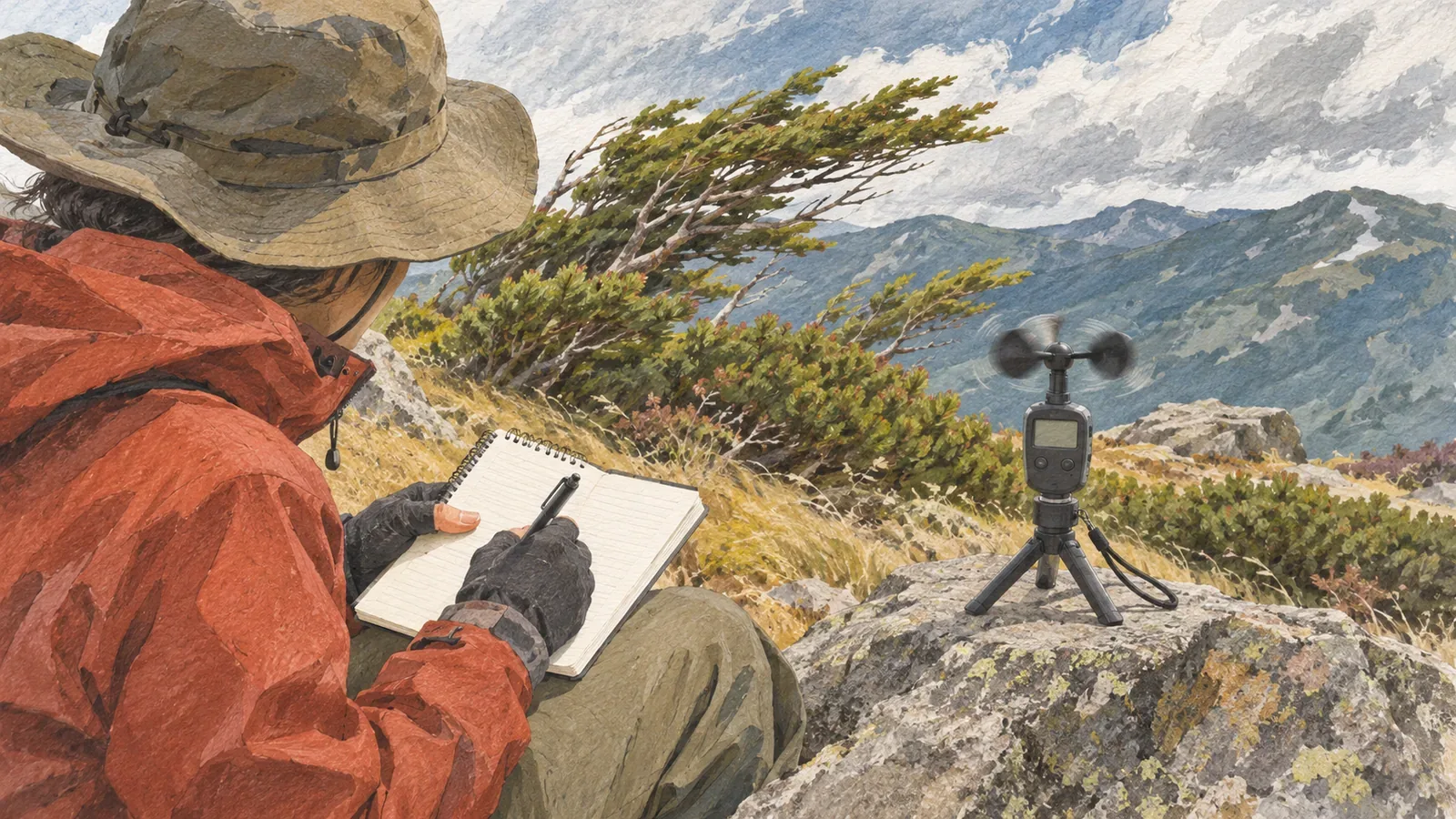
When recording wind on a hike, separate what you heard from the wind speed. Treetops making noise or a hood flapping are observations and cannot be converted directly into m/s. Record the sound to help you recall the circumstances, and record any measurements with their time and location.
What official wind guidance says about sound
The Japan Meteorological Agency’s wind table labels a mean of at least 10 m/s and below 15 m/s as moderately strong, and at least 15 m/s and below 20 m/s as strong. One typical effect in the latter band is power lines beginning to hum. A humming line does not establish the wind speed at that site, and the range cannot be transferred to a different sound heard on a mountain.
Two notes in the table matter here. Terrain and nearby buildings affect wind speed, so it may differ considerably from a nearby station’s value. The table also describes effects typically seen at observed speeds. Actual damage may be greater or smaller.
Humming power lines are an example for places with power lines. The sources we checked do not establish how to convert a sound on a mountain into a wind speed. In our view, sound can vary with where you listen, the things around you and whether you have a hood or hat on. A description in your own words will be easier to interpret later.
Label the type and source of each speed
Record a speed with its supporting details. First, indicate whether it is a mean or a gust. For the Japan Meteorological Agency (JMA), wind speed is a 10-minute mean. The 15:00 value covers 14:50 to 15:00. The agency’s table defines the gust reading as a three-second average.
Gust speed is often about 1.5 times the mean and can reach three times or more in unstable air. These figures do not give a formula for calculating the day’s gusts. Distinguish feeling a sudden increase from measuring it with an instrument.
Include the station name, observation time, whether the number is observed or forecast and, for a forecast, the valid time. With a hand-held instrument, check the manual for the averaging period and the period covered by a maximum. Direction conventions also vary. The Sendai office’s instrument guide uses 36 for north in a 36-direction system. The JMA uses 16 or 36 directions in observations and eight in forecasts. If you copy a code, record the convention.
Leave fields you could not fill blank. If you fill the blanks from the impression of sound, the later comparison loses its value. A number is meaningful alongside what was measured, who measured it and when.
Describe how the wind sounded and the conditions of listening
We suggest four things to note in words. First, the type of sound: rustling treetops, a whistle or a low roar, for example. Second, the pattern: was it steady or brief and sudden? This helps you review how wind strength varied.
Third, the place and clothing, such as woodland or open ground and whether your hood was up. Fourth, note how voices carried, for example “we had trouble hearing at normal volume.” These details describe the listening conditions. They cannot be used to correct sound levels and calculate wind speed. If you do not know how far apart you were, leave room for factors other than wind.
Make the note after stopping somewhere with stable footing and without blocking others. Avoid writing, filming or using the screen while walking. If there is nowhere suitable to stop, write from memory at a rest stop or after the hike.
There is no need to stay exposed for the record. Difficulty walking in the JMA table is a general example and does not set a safety boundary for hikers. Reassess if the wind pushes you, your footing is unstable or you are very cold, even without a number. Clothing and wetness affect how cold the wind feels. A quiet sound is a poor reason to leave windproof or warm layers behind.
Compare the two fields on paper after the hike
Compare the fields at home after descending. Complete the sound field first. Here is an imagined example: “The treetops kept rustling, with a few short, strong roars. We had to raise our voices in the open. Hood up.”
If adding observations, specify whether each is a mean, a gust or a maximum, the station, time and period. The JMA’s wind categories use mean speed, so a gust of 15 m/s does not go directly into the strong wind category. If the mean and peak gust come from different times or periods, simply dividing them gives no sound comparison of the gust ratio.
If your sound notes and the station reading seem to tell different stories, keep the cause open. Terrain, averaging periods and listening conditions may differ. Keep the statements separate: “It was difficult to talk on the ridge. The station below showed this value.” Sound alone cannot establish whether the station value represented the conditions on the ridge.
A few notes are too little to build a conversion from sound to wind speed. Use them to decide where to check information or equipment next time and where your companions had trouble hearing you. Even without a number, the observations can help you review the hike.
Write sound in words and give the source for each number
Describe the sound, its pattern, where you heard it and what you were wearing. Give the type, source and time for wind speeds. Avoid calculating speed from sound or assigning a cause based on a comparison with a distant station. Record safely or after descending, and give priority to footing and how everyone is doing.