
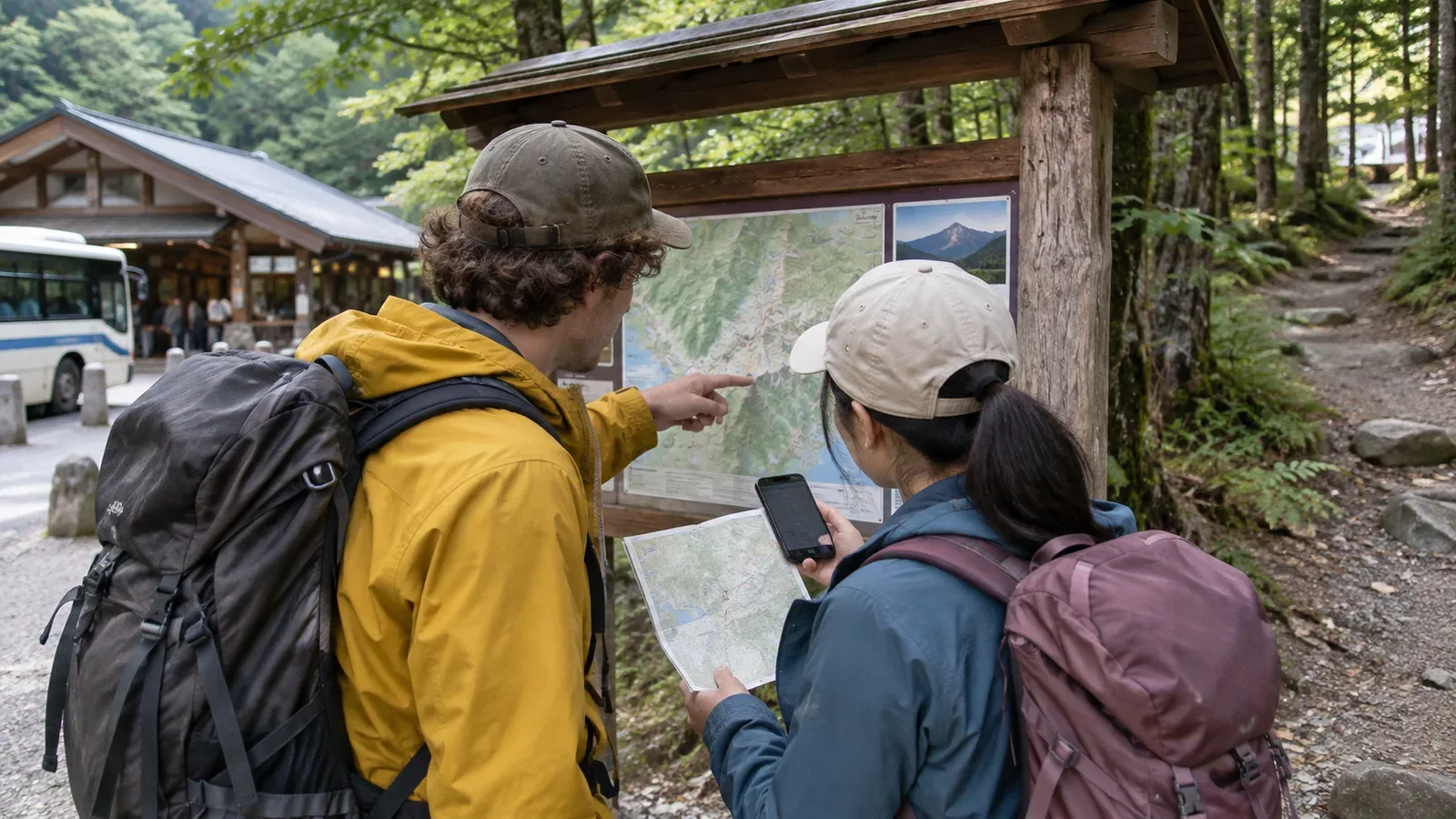
You know the station where you’re meeting, but the sign at the trailhead uses a different spelling. When you hike in Japan with friends from abroad, you may have to find the same place in different scripts. Before leaving, put the Japanese name and its pronunciation alongside the forms used on maps and transport information so everyone can identify the same place.
Put different forms of the same place name side by side
List the departure station, bus stop, trailhead, main junctions, trail exit and return station in the itinerary. For each one, check the official Japanese spelling, pronunciation and the romanised form used by the transport company or facility. Use official maps and timetables to check what a translation app suggests.
For someone new to reading kanji, hiragana or a pronunciation guide can make it easier to speak the name. Recognising the kanji on a sign is a separate task. Share the Japanese spelling as a photo or text that they can show station staff or someone local.
The Geospatial Information Authority of Japan publishes conventions for English map names, such as Mt. Tsukuba for Tsukubasan. For a station or bus stop, also check what the operator uses. JR West’s station guide lists the Japanese name of Kii-Tanabe in kanji, its hiragana reading and the romanised form Kii-Tanabe (紀伊田辺 / きいたなべ).
Pair each name with its location on the map
If bus stops or trailheads have similar names, share their locations on the map, the name of the facility and the exit you’ll use. If you end the hike somewhere else, distinguish the outward and return journeys. Include the map scale and nearby landmarks in screenshots so everyone can check what’s being marked.
For the Nakahechi route of the Kumano Kodo, the tourism information lists Takijiri as a bus stop and Takijiri-oji as a site. You can enter the bus stop and where you’ll start walking as separate landmarks. The guide also describes numbered waymarkers on many trails as a way to work out where you are. Choose maps and landmarks that cover your section before leaving.
Check the original map’s terms and source before making copies to share. Distinguish translations or numbers you add from the official labels. If you can’t confirm a location, a translated name alone won’t settle which place it is.
Give precise transport and meeting details
If you’re booking transport, share the station or stop, date, time, number of travellers, name on the booking and how to collect tickets. A station name and trailhead name can sound similar while referring to different places, so check the operator’s information against the map. Recheck services and conditions shortly before using them.
For the meeting point, agree on a ticket gate, exit or visible landmark rather than the station alone. Discuss how to get in touch if someone’s late and where to wait if there’s no signal. Share personal contact details only as widely as participants need.
Make sure everyone has a map and itinerary and can explain the destination in their own words. Give everyone access rather than storing it all on one device. Paper copies are also an option. Ask your companions which language or spelling works best for them.
If the names don’t match on the ground, stop and check
A sign may use a different romanised spelling from the one you shared, or the same name may appear in several places. Stop and use the map to check your location, direction and the next junction. If needed, show the Japanese name when asking staff or the transport operator.
So you can describe your location in an emergency, share the mountain name, Japanese place names and the last junction or waymarker number you passed. The Japan National Tourism Organization’s safety guide lists the emergency numbers for police and fire or ambulance services. In case mobile service is unavailable, also tell your contact back home the planned route and when you expect to check in.
After the hike, note which spellings were confusing and which landmarks helped. Signs and transport routes can change, so check the latest official information next time.
Recap: share names and locations together
Save the same itinerary on each person’s device and test that it opens without a signal. If you use paper, print it at a size that keeps the map scale and stop locations readable.
Put the Japanese spelling, pronunciation and official romanisation of the trailhead alongside the map and transport details. Give everyone enough information to identify the place themselves. If the names don’t match on the ground, stop and check.