
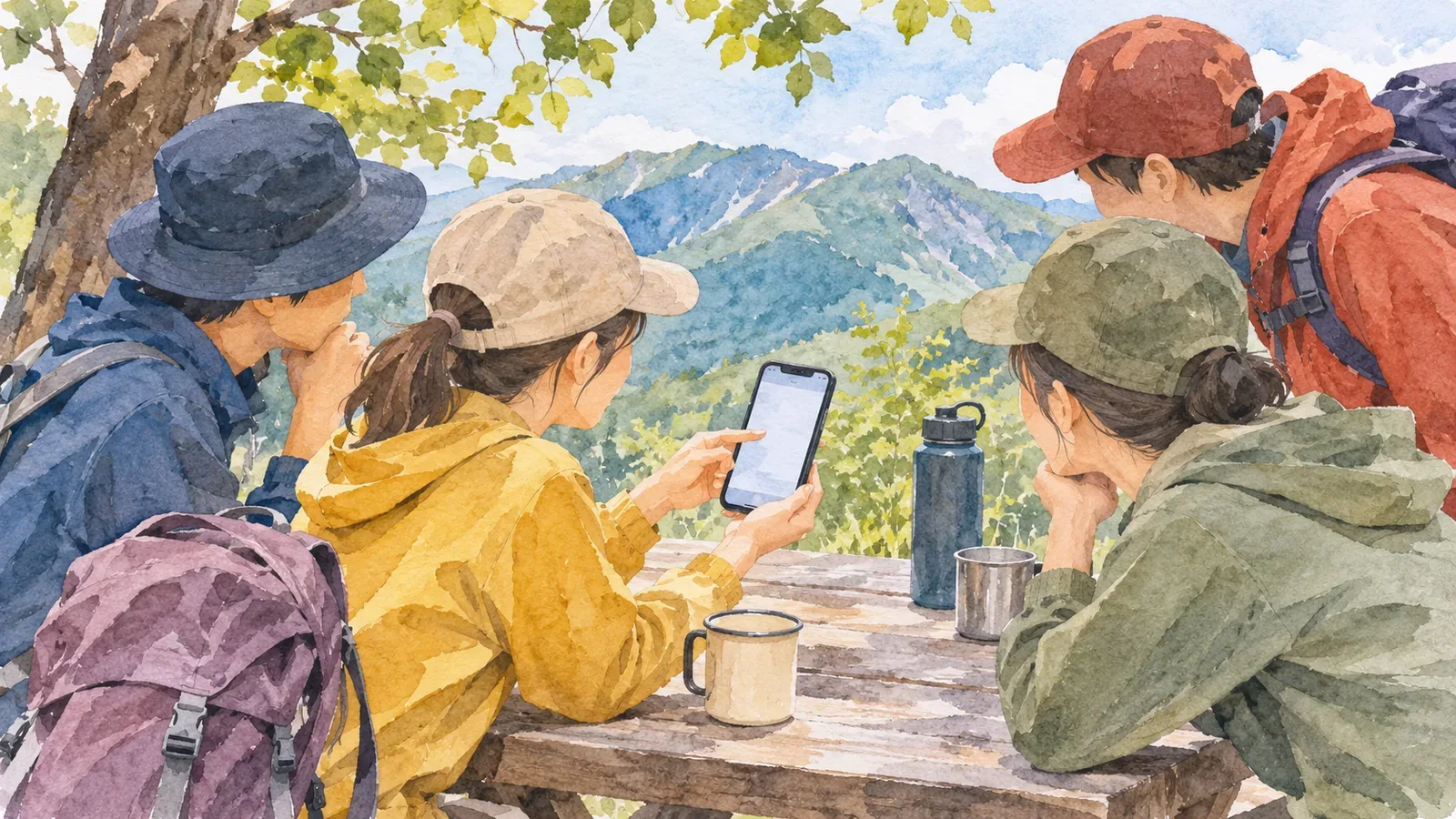
An invitation is easier to decline when it gives the route and conditions up front and says that people can choose to sit it out or turn back on the day.The examples and order below are the editors' suggestions based on Japan's National Police Agency report and the Nagano Prefecture Mountain Center's group hiking manual. They are editorial guidance for writing an invitation.
Give specific details about the route and conditions for joining
The Nagano group hiking manual considers the differences in fitness, skills and experience that can occur in school and organized groups. Even among friends, give everyone enough detail to understand the route and the preparation it calls for.
Japan's National Police Agency recommends hiking in a group with a trusted leader. Make it possible for each person to decide whether to join based on the conditions of the hike. Avoid pressing for a yes to fill the group. If meeting or transport arrangements are complicated, work on them as the organizer without making someone feel responsible for saying yes.
People need to know the route's difficulty and the organizer's approach to decide whether it suits them. Put that information in the invitation and say where to ask questions. Let people decline without detailed reasons, and remind those who want to join to check their schedule and gear.
Six things to include in the invitation
Iwate Prefectural Police says the hiking plan has no fixed format but should include names, addresses, mobile numbers, emergency contacts, schedule, mountain name, type of hike and planned route.Putting the mountain, schedule, type of hike and route in the same order in the invitation makes it easier to move them to the plan after people confirm.That is the editors' suggestion. Add the following six points.
First, give a schedule that includes breaks. The group hiking manual calls for ample time, walking steadily and finishing early. The National Police Agency also advises allowing time for rest. Include breaks in the planned descent time. Second, explain the group's pace. The manual recommends observing the person with the least stamina and matching their pace, which can help the group arrive sooner overall. Saying “We'll match the pace of the person who walks most slowly” may reassure people worried about falling behind.
Third, explain when to turn back. The manual recommends identifying places during route scouting where an unwell participant could turn around, and checking escape routes. The National Police Agency also recommends identifying escape routes in advance. If you have no fixed point, say the decision will depend on time and how people are feeling. Fourth, name the person responsible for the final decision. The manual calls for a clear leader and chain of responsibility.
Fifth, explain how you will handle health concerns. The US National Park Service's Hike Smart guide suggests discussing a planned hike with a healthcare provider if you have a medical condition. You might say, “If you have a medical condition or are unsure about how you feel, talk to your doctor or another healthcare provider and decide what is right for you.” Discuss any accommodations privately, without deciding based on the name of a condition alone. Sixth, give a reply method and deadline.
Say that declining and turning back are both options
Iwate Prefectural Police advises checking health and weather and being ready to cancel if there are concerns. The National Police Agency also recommends stopping early in poor visibility or when feeling unwell. Both address the individual hiker's decision.Putting this option in the invitation can make it easier for someone to raise their decision with the group.That is the editors’ suggestion.
Prepare wording for four situations. Before someone joins, say, “If it doesn't suit you, just reply ‘I'll sit this one out.’ You don't need to give a reason.” Give three reply options, “joining,” “sitting it out” and “I have a question,” with a deadline. Near the date, say, “If you're concerned about the weather or how you feel, please let us know even on the morning of the hike if you decide to cancel.” For the day itself, say, “We may turn back at the planned point after checking the time and how everyone feels.”
For the fourth situation, when someone wants to turn back, the manual's principle is to keep the group together unless there are enough leaders. You could say, “If anyone wants to turn back, we'll decide together how the whole group should proceed and won't send them back alone.” This can make it easier to speak up when someone feels unwell. Consider whether both groups have the judgment, gear, return route and communications to travel safely before any split.
Test the wording at home. Ask a friend who is new to hiking to read it and tell you what they would write to decline, and which part could feel awkward if they wanted to turn back. Their response can help you spot pressure in the wording that you missed.
What to collect after people confirm and what to do before the hike
The group hiking manual describes attaching a list of addresses and emergency contacts to the plan and filing it at the police station responsible for the area. Iwate Prefectural Police asks that the plan also go to family or friends. The National Police Agency recommends sharing it with companions, family and people at work.The editors suggest asking for addresses and emergency contacts only after someone confirms, and explaining what you need them for.The sources list what a plan needs. Keep collection to what is necessary and make room to discuss questions that are difficult to answer.
Filing requirements vary by area. Nagano Prefecture explains how to file for designated trails and carry the completed plan on the hike. Check the latest instructions for the area, including how to make changes. Name the person who will compile the plan in the invitation and make it available for everyone to review. Each participant should know the route even if someone else organizes it.
The manual recommends checking on someone who only sits and does not open their pack during a break. Before leaving, you can say, “We'll ask how everyone is doing at each break. Please say if you want a little more rest or would like to turn back here.” That gives people a clear way to respond.
Summary: give people the details and write in ways to opt out
Give people the details they need and write in ways to opt out. Include the mountain, date, schedule with breaks, group pace, turnaround criteria, person responsible and how to raise health concerns. Include declining as a reply option and acknowledge that people can turn back on the day. Collect contact details after confirmation and explain their purpose. Before sending the next invitation, fill in any missing items and ask someone unfamiliar with hiking to see whether they could write a reply declining it.