
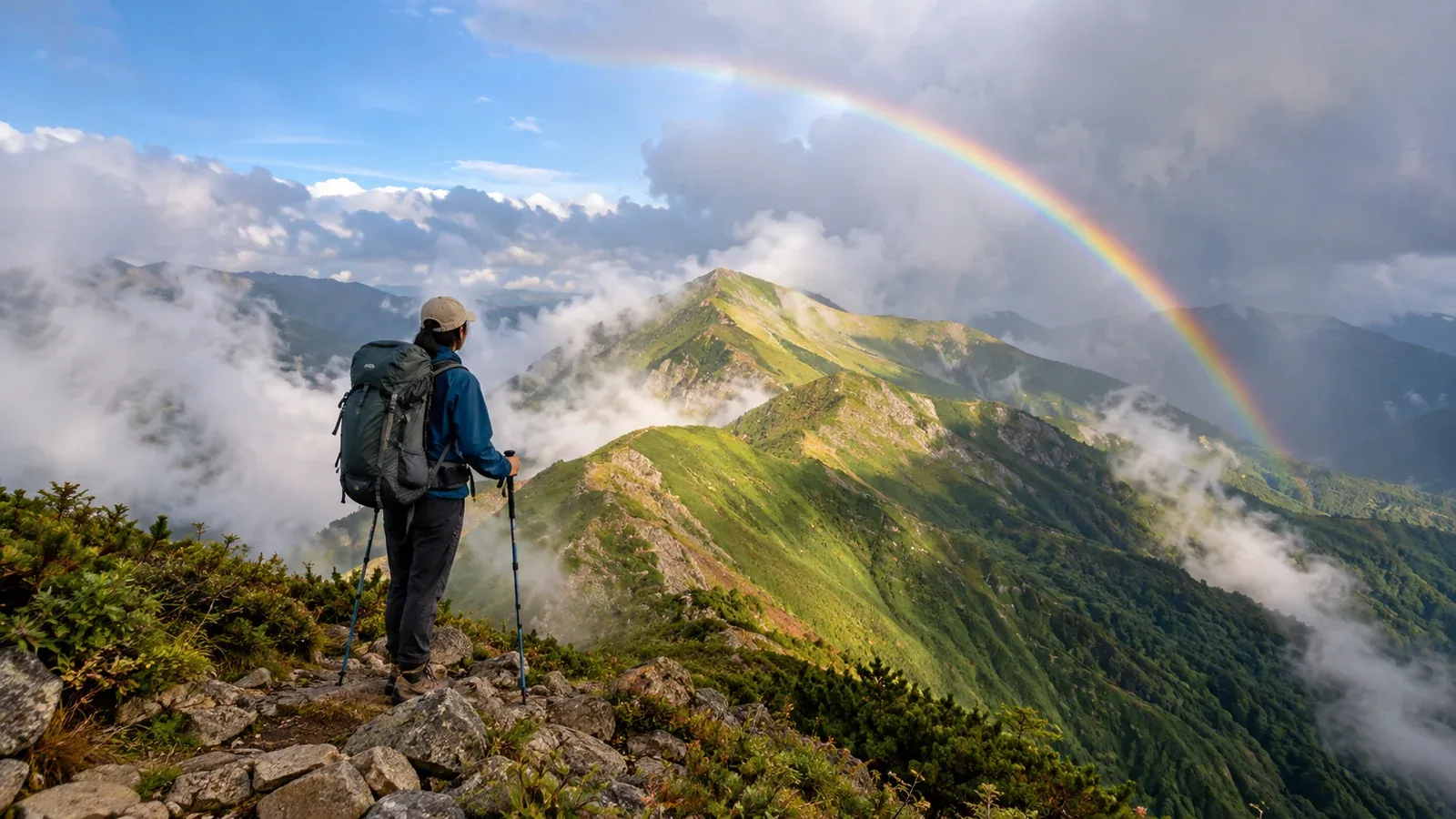
A rainbow appears when sunlight, droplets and your position line up. Understanding why one appeared on a hike helps you know where to look the next time.
A passing shower or mist on a ridge can create the right conditions while the weather is still changing. Check what is happening around you before stopping to watch.
Three conditions for seeing a rainbow
You need three things to line up.
- The arc lies where you can see the drops. On level ground, the sun needs to be less than about 42° above the horizon for the top of a primary rainbow to be visible above it. From a high ridge, you may see a bow in droplets below you even when the sun is higher.
- There are water droplets in the air. Look after a shower, in drizzle or near spray. Sunlight refracts and reflects inside the drops, separating the colors.
- The sun is behind you. The bow is centered in the direction opposite the sun. Look ahead toward the sky or valley.
Ridges and summits often offer a wide view. If the sun comes out behind you as a shower moves away, you may see the bow in the remaining rain.
Where to look on the trail
After a passing shower
On summer afternoons, thunderclouds can bring a short shower followed by a clear spell. If the clouds move east or down into a valley and the sky clears to the west, late sunlight behind you can make a bow to the east. After the shower, locate the sun to narrow down where to look.
On a ridge with drifting mist
When mist and sunlight line up, you may see a white arc called a fogbow. Diffraction in the tiny droplets broadens the color bands until they overlap and look white. Faint color can remain at the edges.
Near a waterfall or stream
Spray can hang over a plunge pool or rapids. When the angle is right, often early or late in the day, face the waterfall with the sun behind you and look for color in the spray.
How to predict the position
Begin on the side opposite the sun, then narrow down the position.
Step 1: Find the direction of the sun. Stand with the sun behind you. The direction of your shadow points to the antisolar point, the center of the bow.
Step 2: Look about 42° from the antisolar point. The outside of the primary bow is a circle with an angular radius of about 42°. Its top is about 42° above the antisolar point. With the sun 20° above the horizon, the top is about 22° above the horizon.
Step 3: Look for sunlit water drops. If rain, mist or spray lies in the right direction and is lit by the sun, a section of the arc may appear.
Tell the primary and secondary bows apart. The primary has red outside and violet inside. A fainter secondary bow can appear outside it, with red inside and violet outside. After finding one, look farther out for the other.
Watch for lightning and changes in visibility
The weather may still be unsettled when a rainbow appears. In summer, thunderclouds may remain nearby after a short afternoon shower. Keep looking for changes around you while you watch the bow.
Check these things at the same time.
- Are new clouds growing near the ridge or summit?
- Can you hear thunder?
- Has the wind changed direction suddenly?
Check the Japan Meteorological Agency’s regional forecast and thunder advisories and the mountain forecast before leaving. Look at the whole sky periodically. If you hear thunder, stop watching and head immediately for a substantial building or a metal-roofed vehicle with its windows closed.
Next time you are on the trail
After a shower, find the sun and look for water droplets in the opposite direction. Understanding why the rainbow appears also helps you notice changing weather. A certified guide can help you practice making weather decisions on the trail. The Nordwand app can connect you with guides and hiking communities.
Further reading
- World Meteorological Organization, International Cloud Atlas
- Japan Meteorological Agency, mountain weather information
- UK Met Office, rainbows