
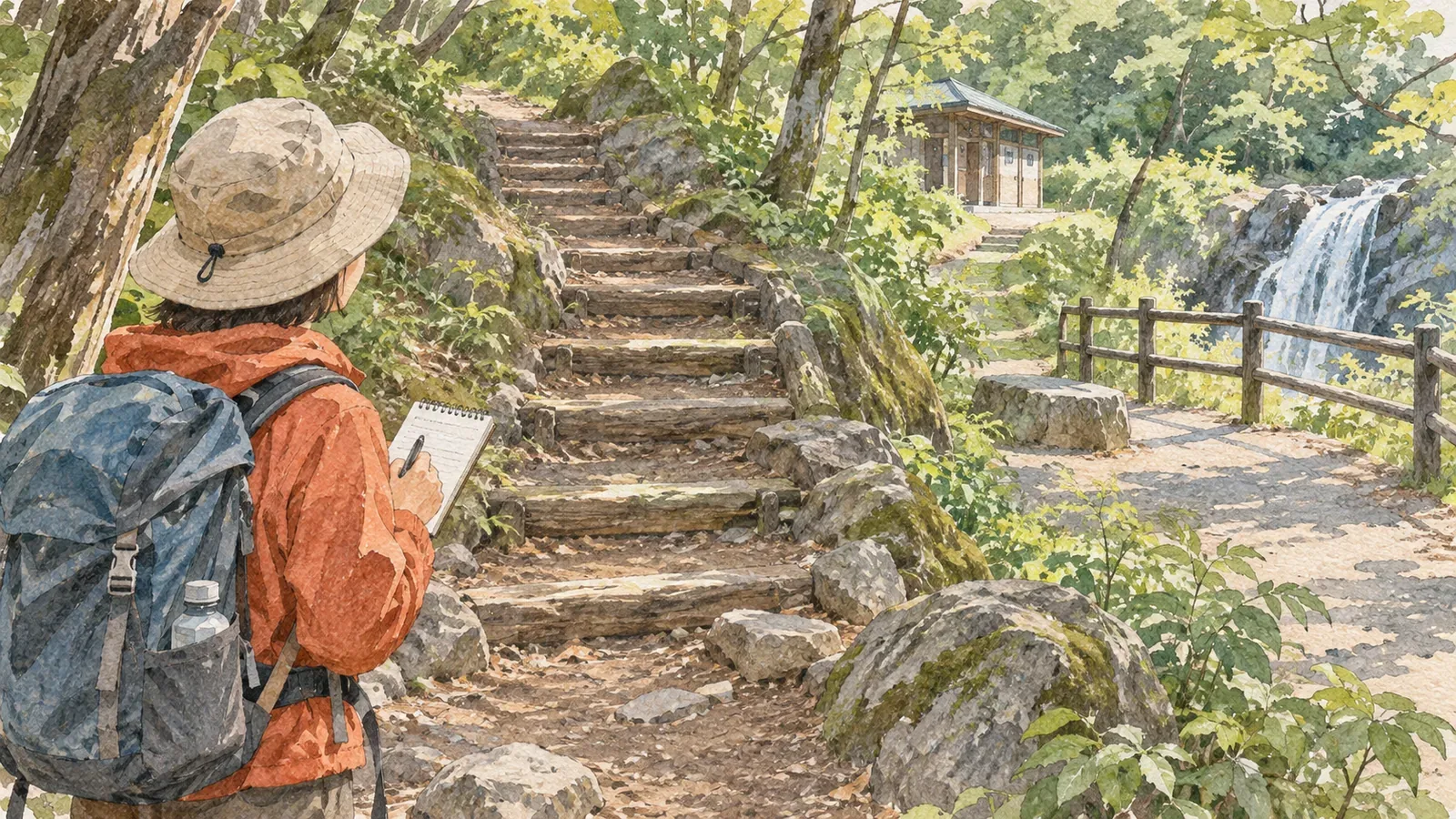
“Only a few hundred metres each way” tells you the distance. It doesn’t tell you if there are stairs or high steps along the way. Different people and mobility aids need different conditions. Find out what the path is like before leaving so you can choose a suitable route.
Find out what’s on each section
Use an official map or facility guide to trace the route from the entrance to the places you want to visit. If there are stairs, check where they are, how many steps there are, whether there’s a handrail and whether an alternative exists. Ask about individual steps at specific points such as the entrance, both sides of a bridge or a building doorway.
Labels such as “accessible” or “easy walking” are a starting point. They may not cover what you need. The Ministry of the Environment’s list of universal design features by national park says provision varies and that visitors should ask in advance. Ask the person about their needs and any mobility aids, and check each section against that information.
Japan’s Ministry of Land, Infrastructure, Transport and Tourism gives examples of accessible paths and entrances in its urban park materials. It also describes exceptions for very steep terrain or areas that need environmental protection. These urban park examples don’t tell you what to expect on every nature trail.
Check the surface as well as the stairs
A route without stairs can still have steep slopes, uneven stone paving, gravel or joints in boardwalks. The ministry’s guidance shows how uneven stone paving can make movement harder for wheelchair users and older people. Check the actual surface as well as whether it is paved.
Kamikochi’s official FAQ explains that many of its trails are unpaved, including boardwalks and gravel paths. Check when and where photos or videos were taken. A flat section in one image doesn’t tell you what’s beyond it. Ask the manager before visiting what conditions are like after rain or construction.
Width, corners and the space around rest areas may matter too. Check not only that someone can get through but whether they need room to turn or pass others. If measurements are unavailable, ask for photos or descriptions and record what remains unknown.
Trace the whole route, including the return
Check the route all the way from the car park or bus stop through the entrance, points of interest, benches and toilets to the exit. An exhibition room may have no steps, while the route to it has stairs. If you return the same way, the slopes will be in the opposite direction.
For toilets, check the equipment you need, steps on the way there and opening hours. The ministry’s urban park guidance emphasises telling people which facilities and features are installed. Check the facility’s information and ask specifically about anything unclear.
DPI Japan reports requests for wheelchair users to be able to reach the places people come to see. Share the path information with your companion and ask where they want to go and what help they would like. Ask before touching them or their mobility aids, and include them in decisions about the route.
Make clear what you haven’t confirmed
When contacting a facility, give the visit date and section you want to use. Ask specific questions such as “How many steps are there?” and “Is there a route without stairs?” Record when staff can’t answer and consider another facility or a shorter route. Tell your companions when you checked and what the answer covered.
Works or weather can change conditions by the day of the visit. Follow on-site guidance and change plans if needed, for example by turning back or visiting an exhibit near the entrance. Have something else to enjoy if a step can’t be crossed safely.
If you share an account afterwards, give the date, route you used and specific steps you noticed. One person’s experience is a useful clue. Access for others and future conditions can differ. Point readers to the facility’s latest information.
Recap: check what the path is like, even if it’s short
Check stairs, steps, slopes, surfaces and the routes to rest stops and toilets, as well as distance. Ask each person what they need and specify sections when checking with the facility. Choose a plan you can change if important details are still unknown.
References and sources
- Ministry of Land, Infrastructure, Transport and Tourism: overview of accessibility guidelines for urban parks
- DPI Japan: discussion on universal design in national parks, 13 December 2024
- Ministry of the Environment: universal design features by national park
- Official Kamikochi website: frequently asked questions