
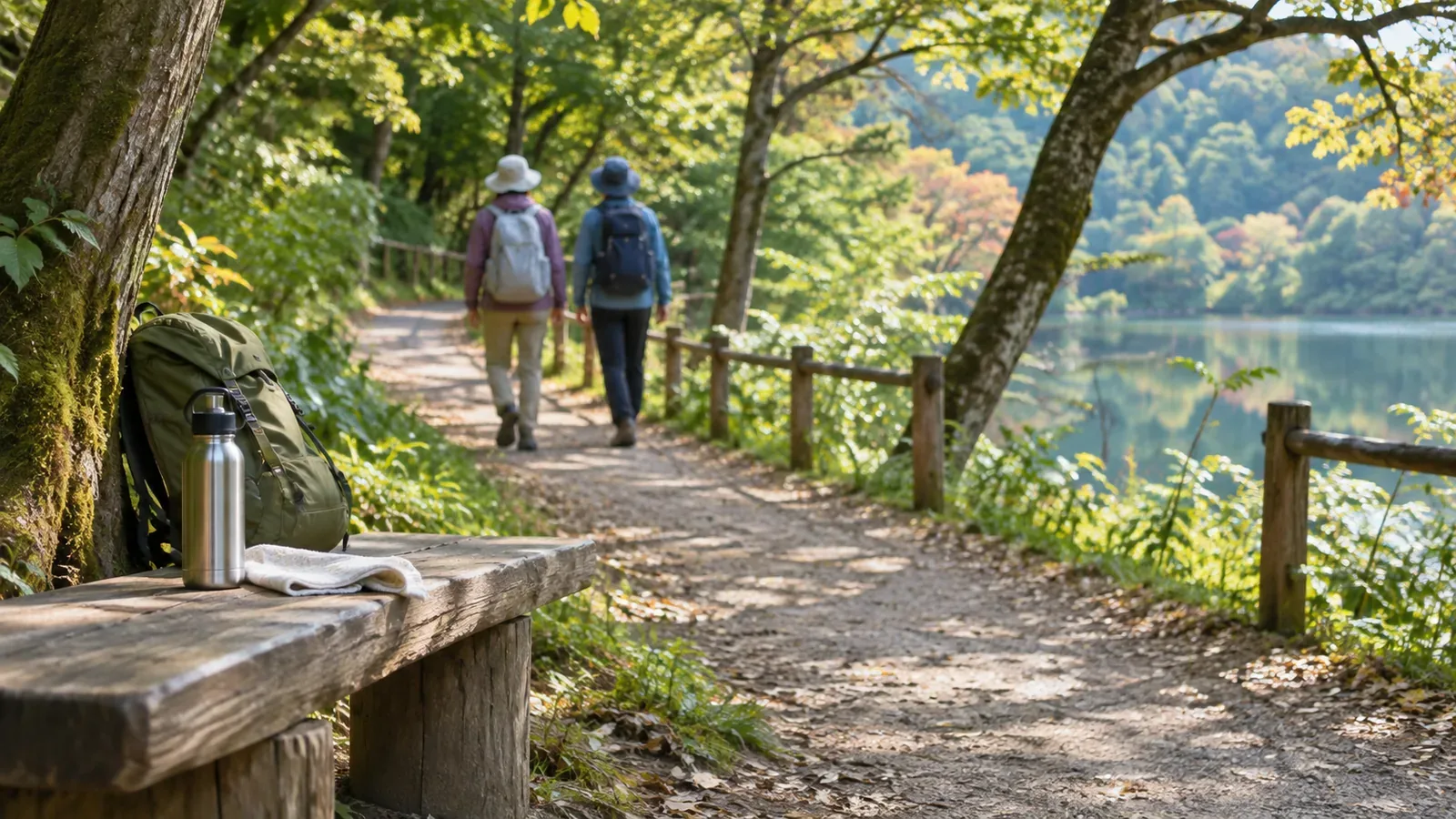
A mountain outing can mean listening to the forest, looking out over the water or resting where you like. Walking part of a nature trail at a pace that works for you can make a good day out without a summit. Choose a path based on what you want to see and the conditions you need.
Start with what you’d like to see
Start by deciding how you’d like to spend your time. Japan’s Ministry of the Environment says a principle of universal design in national parks is that visitors can choose how far to go and what to do according to their abilities and interests. If you want shade, a view or information about plants, look for options with the facilities and access you need. Ask what each companion wants.
Official park and visitor centre information may include maps, places of interest and facilities. Check the route to the view and how to reach it from the entrance or car park. A nearby destination can still have steps or a steep slope along the way.
DPI Japan reported a discussion on universal design in nature parks in which participants asked for wheelchair users to be able to reach the places visitors come to see. Check whether you can reach the particular sight you want to visit. A short route doesn’t necessarily get you there.
Check path conditions as well as distance
For each option, look at the length and time as well as the surface, slopes, steps, stairs and width. A paved path may be uneven and a short path can be steep. Use descriptions like “easy walking” as a starting point and check the conditions you and your companions need.
Japan’s Ministry of Land, Infrastructure, Transport and Tourism gives uneven stone paving as an example of something that can hinder wheelchair users and older people in urban parks. The guidance is for city parks. It’s an example of why the state of the surface matters as well as the material.
Check for benches and toilets and the route to the facilities you plan to use. Kamikochi’s official FAQ says some routes have long gaps between toilets or rest areas. See how the facilities line up with the part you want to walk. Ask the manager about opening hours and current conditions and have an alternative if a facility is unavailable.
Plan a walk you can end early
On an out-and-back route you can walk to a spot you like and turn around. A slope you go down on the way out will be uphill on the way back. On a loop, check for shortcuts and how you’ll get from the exit to transport.
Ask beforehand how far each person wants to go and how they’d like to ask for a break. Even if someone seems to need help, ask what they want before deciding how to assist.
Adapt the plan to the weather, the path and how people feel. Spending time at a bench and then turning back or visiting an exhibit near the entrance can be a good day out. Leave time for breaks and the return rather than pushing to finish a planned distance.
Ask the manager specific questions before leaving
If the official site doesn’t answer your questions, tell the facility which section you want to use, how you’ll get around and what you need to know. For wheelchair access, for example, ask about steps and surfaces from the entrance to the viewpoint or the route to the toilets.
Note the answers and the date you checked, and share them with your companions. Works and weather can change conditions, so check again shortly before leaving. Keep another option if important information is missing so you can adapt on site.
Afterwards, you can note what you enjoyed, where it was easy to rest and which information helped you decide. If you publish it, give the date and make clear it describes your own experience. Access can differ for other people.
Recap: choose a route to the places you want to see
Choose what you’d like to see and check the surfaces, steps, rest stops and transport to get there. Ask what your companions want and keep the option to finish early. Plan for time you’ll enjoy on the day.
References and sources
- DPI Japan: discussion on universal design in national parks, 13 December 2024
- Ministry of Land, Infrastructure, Transport and Tourism: overview of accessibility guidelines for urban parks
- Ministry of the Environment: protecting and using national parks, universal design
- Official Kamikochi website: frequently asked questions