
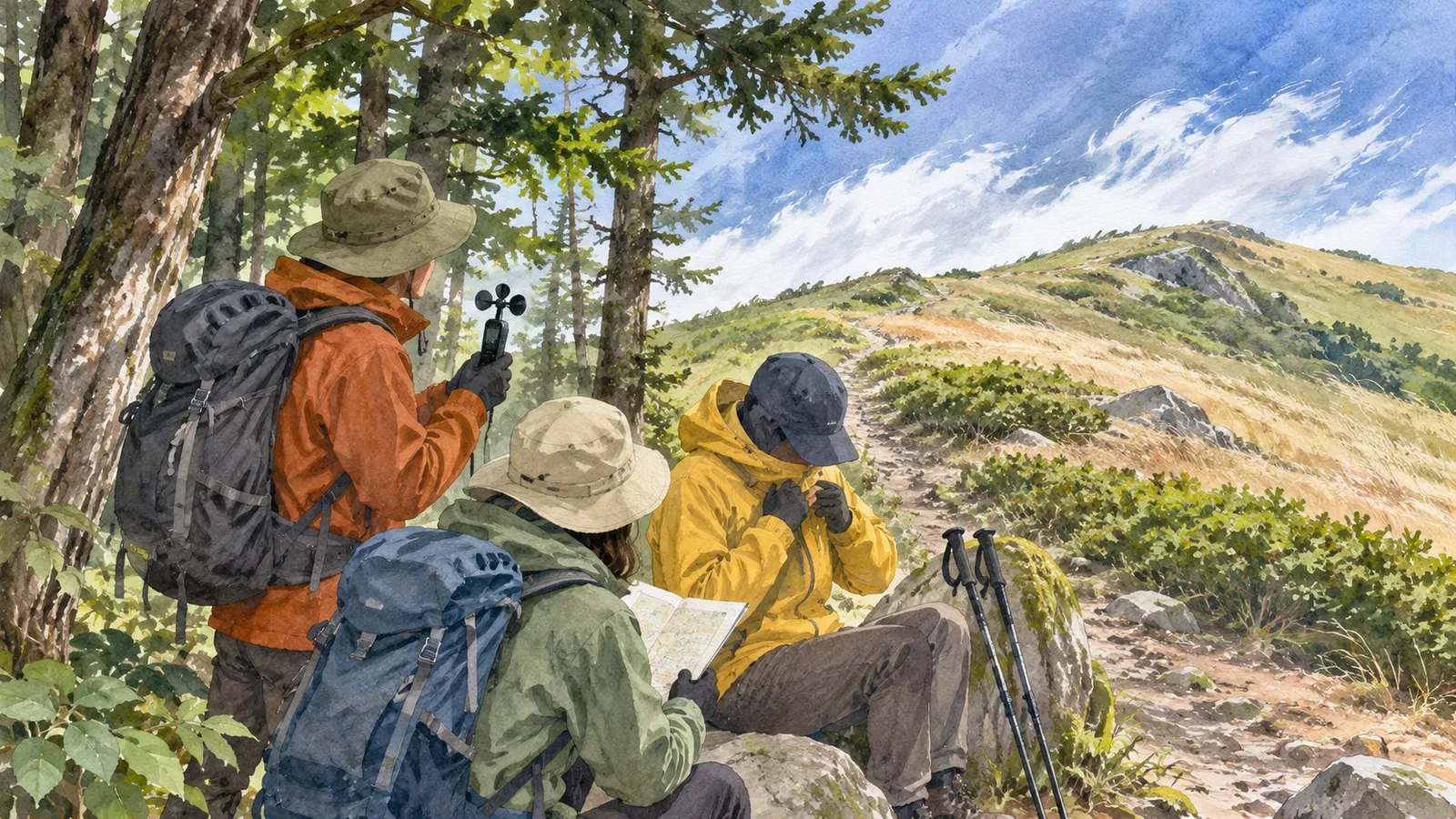
Before moving out of the woods onto an exposed ridge, check the forecast for the terrain ahead, what you see around you and your equipment. Calm air in the woods can coexist with strong wind on the ridge. Using Japan Meteorological Agency (JMA) guidance and other sources, we explain how to separate measured wind from what you feel. Record only when it is safe, and avoid stepping into strong wind just to compare.
Wind in the woods tells you little about wind on the ridge
The JMA’s wind table notes that terrain and buildings affect wind speed, which can differ greatly from readings at a nearby station. Keep separate the station value at the foot of the mountain, what you feel in the woods and conditions on the ridge ahead. Calm at one point gives no assurance about the next section.
The Japan Weather Association’s hiking guide says wind is often stronger near ridges and summits and recommends wind protection. Check a topographic map and local information for exposed stretches and routes back. The trees do not reduce the wind by a fixed factor, and the boundary of the woods may be hard to identify.
Choose a stopping place with safe footing and surroundings. If you can prepare earlier, stop there to check the forecast and how everyone is doing. Watch for falling branches and trees. The presence of trees alone gives no assurance that a rest stop is suitable.
Identify what each wind number measures
The JMA’s wind speed is a 10-minute mean. A 15:00 observation averages 14:50 to 15:00, rounded to the nearest whole m/s on the AMeDAS map. Gust speed is often about 1.5 times the mean and can reach three times or more in unstable air. Those factors do not calculate the gusts on a particular ridge from a forecast.
The JMA’s current gust reading is a three-second average. In 2007 it announced a change from individual samples taken at 0.25-second intervals. Check the averaging period of a hand-held instrument before using it. If you are describing a sensation, write something like “it suddenly grew stronger” separately from measurements.
Wind direction is where the wind comes from. A wind from north to south is a north wind. The JMA uses true north, 16 or 36 directions in observations and eight in forecasts. For an impression, note how it related to your heading, such as “from the left as we walked.” Add units such as m/s to a measurement, and leave unknown direction or strength unspecified.
Record what you can from a safe place
Separate the prevailing strength from gusts, write where the wind came from and give the number of minutes you watched. This is our suggested record format. Only stop where the footing and surroundings are safe. There is no need to measure from an exposed place.
Note time and location, where the wind came from, whether it pushed you, any sudden strengthening, air temperature and clothing. “Thick branches were swaying” is an observation. Ten minutes of watching still gives no measured 10-minute average. Move to safety rather than staying in cold or strong wind for a fixed period. You can write from memory afterwards.
If you record a measurement, note the model, duration, location and height. Avoid going out of the woods or measuring again on a windy ridge just to complete the record. Conditions differ between your sheltered point and the ridge, and a brief observation cannot establish the wind speed ahead.
Use the notes to think through what you may face on the ridge
Preparing for cold calls for more than a subtraction. The US National Weather Service wind chill index is based on heat lost through exposed skin and assumes, among other things, no effect from the sun. Avoid combining a general temperature drop with altitude and the shortcut “1°C per 1 m/s of wind” to calculate how cold the ridge will feel. Consider the forecast, local wind, rain, wetness and clothing separately.
Adjust equipment early from a safe place to avoid rushing when the wind strengthens. The JMA table describes typical effects such as difficulty walking and falls. Those speeds do not set a point up to which it is safe to continue. Reassess the hike if footing is unstable, the cold is severe or a companion is struggling, even without a number.
If the forecast direction differs from what you felt, leave room for multiple explanations. Check differences in location and time and leave unknowns open. Before setting out, agree on decision points for cancelling or shortening the hike, routes back and how anyone can speak up. Reassess promptly when conditions change.
Calm air below the ridge tells you little about conditions on it
Conditions in the woods and on the ridge differ. From a safe place before leaving the trees, check the forecast, equipment and how everyone is doing, and consider turning back if conditions are difficult. Separate measurements from impressions. Avoid using a multiplier to predict gusts or a brief observation to assert conditions farther ahead. Record only when you can do so safely and avoid exposed ground merely for comparison.
References and sources
- Japan Meteorological Agency, Questions about wind
- Japan Meteorological Agency, Wind terminology
- Japan Meteorological Agency, Wind strength and its effects
- Japan Meteorological Agency, Change to the method for measuring gusts (October 26, 2007)
- Japan Weather Association tenki.jp, What hikers should know about cold (September 11, 2025)
- US National Weather Service, Understanding Wind Chill