
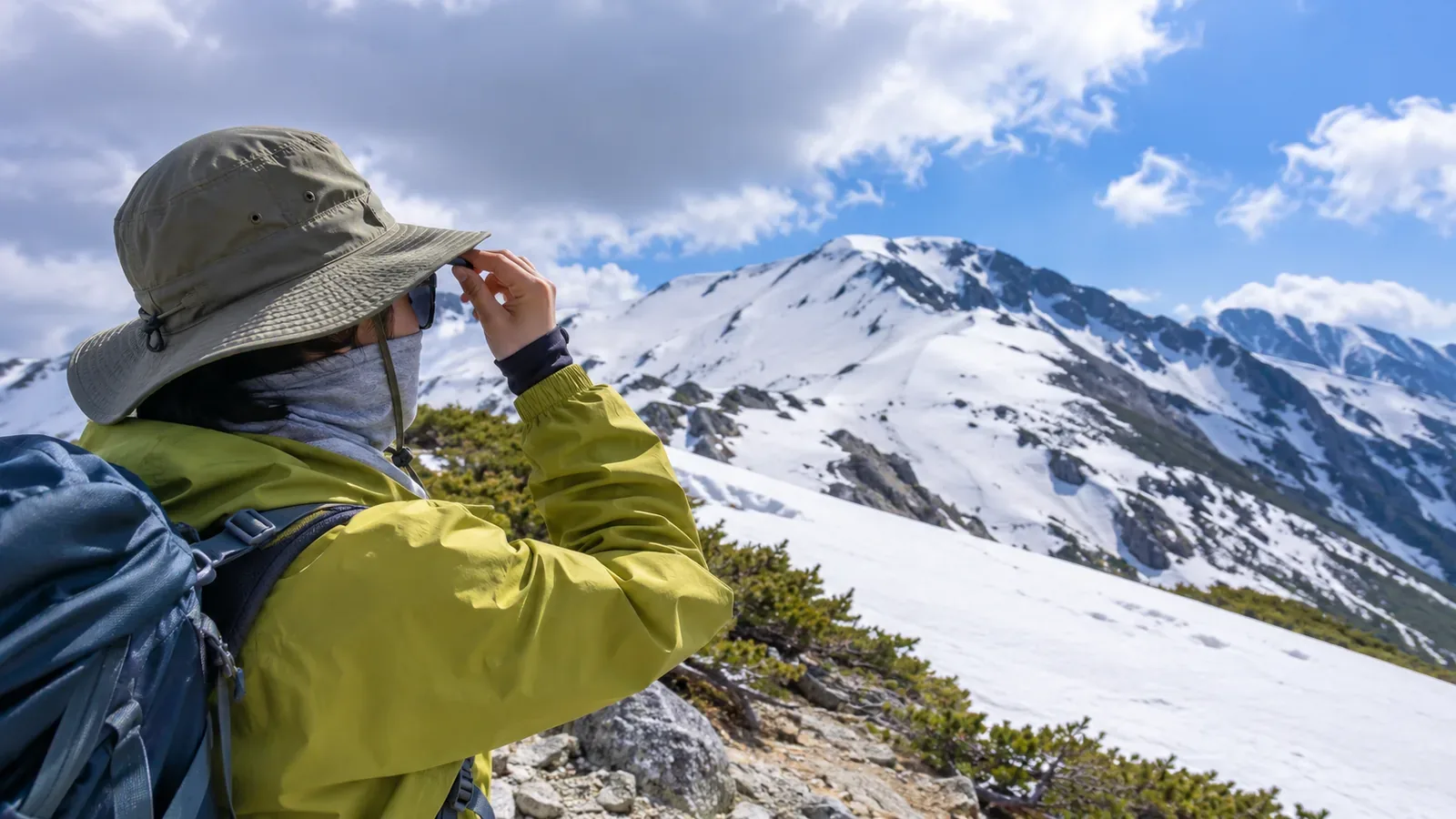
Check the UV forecast before heading into the mountains, even when it feels chilly. The warmth you feel and the intensity of ultraviolet radiation are different. Use the Japan Meteorological Agency’s UV index and consider elevation, snow cover and the hours you will be outdoors when deciding how to protect yourself. Applying a fixed multiplier to a forecast cannot tell you exactly how much UV you will receive on the mountain.
How warm you feel tells you little about UV
Japan’s Ministry of the Environment explains in its UV health handbook that infrared radiation makes sunlight feel warm, while you cannot sense the UV that causes sunburn. A chill in the air is no reason to assume you will burn less easily. The handbook reports that 80–90% of UV-B passes through thin cloud. On a cloudy day with a cold wind, our editors think it can be especially easy to overlook the sun and forget protection.
The UV index provides a common scale for the intensity of ultraviolet radiation. The Japan Meteorological Agency uses it to publish information for everyday sun protection. The agency describes it as an international index whose use the WHO recommends. Think of it as a separate forecast for the strength of the day’s UV.
When UV exposure matters even in the cold
The sources point to several conditions worth watching in cold weather. One is early spring. Citing WHO guidance, Japan’s environment ministry notes that strong UV calls for particular care even when the air is not especially warm.
The ministry’s handbook explains that reflection off snow can increase exposure even in winter. It gives illustrative reflectance figures of 80% for fresh snow and 10% or less for grass or soil. The fraction varies among snow surfaces, and your exposure also depends on which way you face and the surrounding terrain. Keep up your protection in snowy mountains throughout winter.
Elevation also matters. The weather agency and environment ministry both explain that UV radiation increases with elevation as the layer of atmosphere above you gets thinner. The agency gives a rough increase of 1% per 100 m, while the ministry gives 10–12% per 1,000 m.
Compared with a cloudless sky, the weather agency estimates average UV index levels of 80–90% through thin cloud, about 60% in overcast conditions and about 30% in rain. Conditions vary. When the sun shines through a break, scattering by clouds can sometimes raise the UV index above its cloudless value. Look at UV information as well as the sky instead of applying a fixed percentage.
How to read UV information and use it in the mountains
The agency publishes two maps worth comparing. The weather-adjusted forecast shows the average UV index expected for a given area and time. The clear-sky forecast gives an indication of how strong UV can be when the sun briefly appears, even on an overcast day. If the maps differ widely, plan for the possibility of a sharp rise when the sun comes through a break in the clouds. This is an editorial suggestion based on the agency’s explanation.
The maps use a representative elevation for each cell of roughly 20 km by 20 km. Where mountains and plains share a cell, that elevation usually represents the plains, so the forecast may not reflect a summit or a particular ridge. The agency’s estimate of roughly 1% more UV per 100 m helps explain why mountain conditions can differ. It is too broad a rule to turn the published value into a precise summit forecast.
The agency notes that unusually clear air or highly reflective surfaces can bring stronger UV than indicated. Clouds and shade also affect exposure, so the displayed number is not necessarily a lower bound. The model already accounts for typical winter snow reflectance in some areas. Doubling the value wherever you see snow would count reflection twice.
A pre-departure routine to try
The day before and the morning of the hike, check both the weather-adjusted and clear-sky forecasts for the area. Look at the times you will be walking and note the planned route’s elevation, snow cover and exposed sections. This helps you understand how the trail differs from the representative location. It cannot give you a personal UV dose by adding the factors together.
UV is generally strongest around solar noon and during summer in Japan. The peak hour varies with location and weather. Compare the hourly forecast with your itinerary and see whether you can spend less time in exposed places, instead of relying on a fixed window to avoid.
The WHO recommends taking particular care when the UV index is 3 or higher. Start combining shade, clothing, a hat, UV-protective sunglasses and sunscreen on exposed skin at that level. There is no need to wait until 6 or 7 to put on protective clothing. When UV is especially strong, consider changing the itinerary or date. Scattered and reflected UV can reach you in the shade, so keep using protection there.
Sunscreen should never be used to prolong sun exposure. Apply enough according to the label and plan to reapply if sweat or wiping removes it. After the hike, review what you wore and whether you were able to reapply it. An absence of redness does not establish a safe limit for next time. Use past UV data to understand the season and use the current forecast to plan the day.
In short: check UV separately, especially on cold days
Even when you feel cold, plan for UV exposure. Check the index for the area and hours of your hike and think about how elevation, snow and shade make conditions on the trail different from the forecast. Treat the number as a guide. Combine changes to the itinerary with clothing, a hat, UV-protective sunglasses and sunscreen.
References and sources
- Japan Meteorological Agency: What Is the UV Index?
- Japan Meteorological Agency: Guide to UV Information
- Japan Ministry of the Environment: UV and Environmental Health Handbook 2020
- Japan Meteorological Agency: Clouds and Ultraviolet Radiation
- WHO: Radiation — Protecting against Skin Cancer
- Japan Meteorological Agency: UV Data Archive