
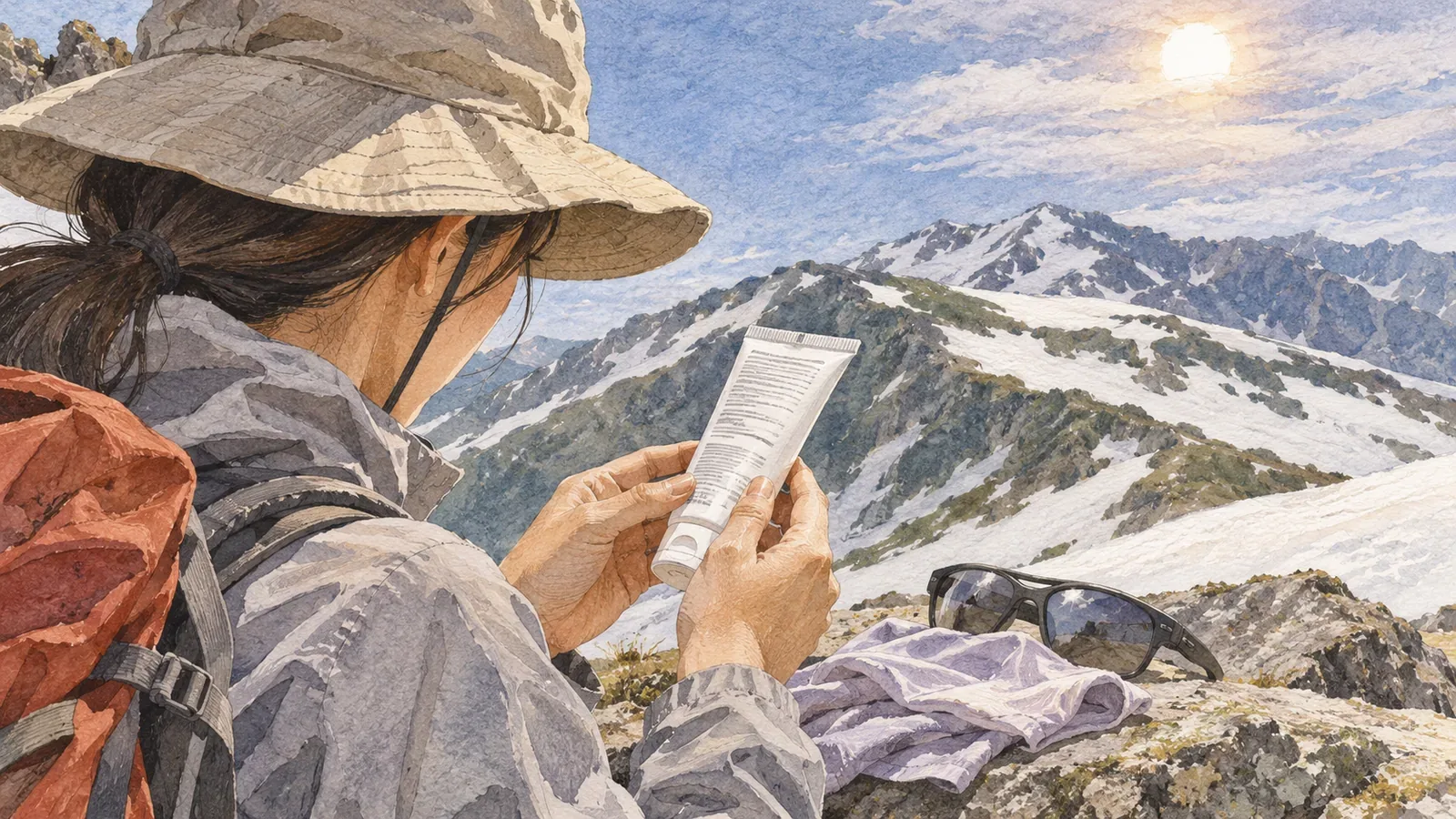
Read the sunscreen instructions before heading out and check whether the product and how you use it fit the day’s activities. Japan’s environment ministry handbook explains SPF and PA, gives general guidance on application and reapplication, and advises checking each product’s features and directions. Here is what to look for and when to use it on a hike.
Sunscreen helps protect skin when sun exposure is unavoidable
The ministry’s UV health handbook treats sunscreen as protection when you cannot avoid exposure. Spending longer in the sun is still a bad idea. It also explains that protection depends on using the product correctly. Our editors suggest checking whether you can follow the directions, as well as looking at how strong the product appears. That starts with reading the instructions before you go.
How the sun feels can mislead you in the mountains. The handbook explains that infrared radiation feels warm and that people cannot sense the UV that causes sunburn. Strong UV calls for particular care even in the cooler temperatures of early spring. Exposure also accumulates through the day, and a break does not mean you will avoid sunburn. Our editors suggest using the conditions listed in the instructions to decide when to reapply, even if you feel cool or have just rested.
The WHO recommends taking particular care at a UV index of 3 or above and combining clothing, a hat, sunglasses, shade and sunscreen. You can use sunscreen at 3–5 along with shade. There is no need to wait until the index reaches 6–7. Consider changing the itinerary to avoid the strongest hours, and keep time in the sun short even after applying sunscreen.
Where regional UV information can differ from mountain conditions
The Japan Meteorological Agency’s UV figures use a representative elevation for each cell roughly 20 km square. If a trail or summit is at a different elevation, the displayed value may not apply directly. UV generally increases with altitude, but the difference in height from the trailhead alone cannot tell you how much stronger it will be than forecast. Account for clouds, snow and when you will be outside.
The weather agency explains that unusually clear air or very reflective surfaces can bring stronger UV than shown. The environment ministry also warns about reflection from snow. Figures illustrate individual conditions. Avoid adding a blanket amount for snow or reducing the forecast simply because it is cold.
The agency estimates that the UV index under thin cloud averages around 80–90% of the cloudless value. Depending on the clouds, it can be higher than in clear skies. Diffuse and reflected UV also reach the shade. Keep up sunscreen and other protection even if the sky looks overcast or the shade feels cool.
Instructions vary in how much they account for mountain conditions. When a condition is not addressed, plan how a hat, clothing or a different schedule can help protect you.
What to check in the instructions before leaving
Look for six things in your product instructions: the amount and application method, when to apply, how to reapply, areas to avoid or reasons to stop using it, how to remove it, and storage and expiration. The details vary by product. Use this list to find the information for the one you have.
Time matters for reapplication, and so do sweat, water, wiping and friction from clothing. Japan’s environment ministry recommends reapplying when you think the sunscreen has rubbed off, otherwise every 2–3 hours. The WHO recommends reapplying every two hours, especially after sweating and similar activities. Use this guidance alongside your product’s instructions and carry enough sunscreen where you can reach it after wiping off sweat or in similar situations.
SPF mainly measures protection against redness from UV-B. PA rates protection against UV-A. These labels come from test conditions. They do not tell you how long it is safe to be outside or how long you can go without reapplying. Read your product’s instructions for amount, application areas, water resistance and removal. Ask the manufacturer if anything is unclear and carry a photo or note of the directions.
You can practice at home. With the instructions in front of you, recall your last hike and write down which direction would have applied in each situation. Any situation you cannot match to a direction is one you might be unsure about on the day. Work through it at home.
Put the conditions and instructions on one sheet
The day before and on the morning of the hike, compare the agency’s weather-adjusted and clear-sky forecasts for the area and hours you will be walking. The clear-sky forecast helps you consider a break in the clouds. Use past observations and analysis graphs to see seasonal patterns and the current forecast for the day.
Check whether the itinerary puts you on snow or in unshaded terrain for long around solar noon, when UV is generally stronger. A past monthly average plus a percentage for elevation cannot tell you the UV on a particular mountain. See whether you can change plans to avoid the strongest hours, cover skin with clothing and properly apply sunscreen to exposed areas.
In your plan, write down times and places, the forecast for your hiking day and situations that may require reapplication, such as sweating or wiping. Note the date the forecast covers and the update time so you can tell a forecast issued the day before from a value for the previous day itself. Keep the container accessible so you can reapply somewhere stable that leaves the trail clear.
After coming down, think about areas you missed and occasions when you could not reapply enough. A lack of redness does not prove your routine is safe every time. If irritation or a reaction occurs, follow the product precautions and seek medical advice if symptoms are severe or persist.
In short: read the instructions before planning for mountain sun
Consider both the protection stated on the label and whether you can use enough and reapply it. Check where, how much and how often to apply and how to remove it. Plan around the conditions of the hike. Combine sunscreen with clothing, a hat, shade and a schedule that limits exposure.