
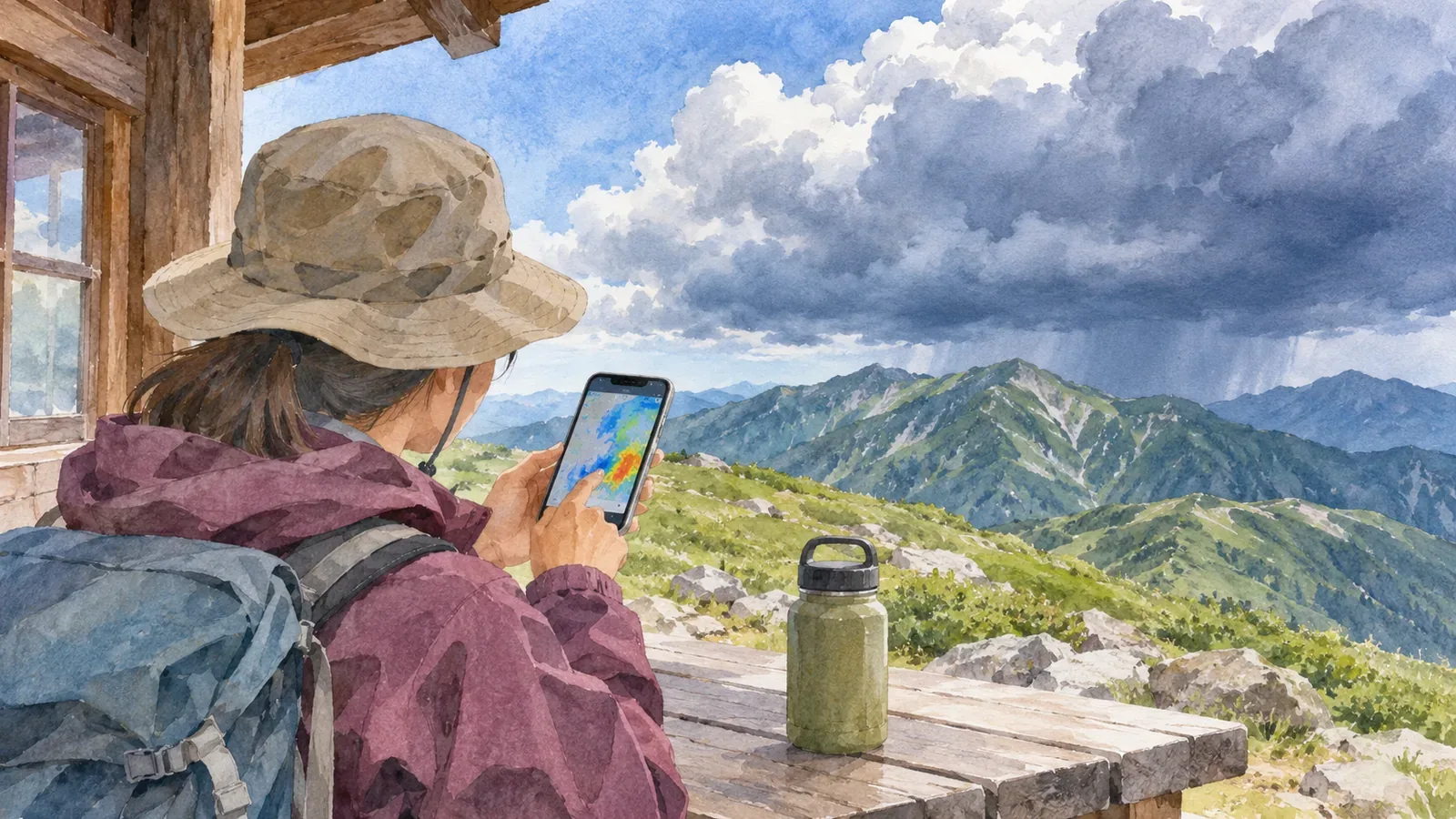
Before reading the colours or numbers on the Lightning Nowcast, check when it was updated. The Japan Meteorological Agency (JMA) updates it every 10 minutes and provides a view up to one hour ahead. This article draws on the agency’s guidance as of October 27, 2026 to explain how to use it in planning and on the trail. Check where your usual service displays the timestamp before you leave.
The update time tells you how current the display is
The Lightning Nowcast analyses lightning intensity and potential on a 1 km grid and forecasts 10 to 60 minutes ahead. The analysis uses detected discharges from the lightning monitoring system, radar observations and other data. The forecast considers the direction in which storm clouds move and whether they are developing or weakening. A new update is issued every 10 minutes.
Distinguish the reference time of the analysis from the time for which the selected forecast is valid. A 60-minute forecast based on 10:00 is for 11:00. Reopening it at 10:30 does not make it a forecast for 11:30. Treat the time you opened it as a separate timestamp. An old screen omits subsequent observations, so avoid relying on it for current storm cloud positions or what happens next.
Identify the product and check the analysis and forecast times against the current time. Automatic refresh depends on the service, so make sure you have the latest data. Look at your current location, the places ahead and how long it will take to reach them. At signs of danger such as thunder, seek shelter immediately without waiting for an update.
The precipitation and tornado nowcasts are separate from the Lightning Nowcast. The JMA explains that its nowcasts refresh every five or ten minutes depending on the product. The lightning product updates every ten. Check which display you have open so you can read the right timestamp.
Read activity levels alongside the update time
The JMA gives different guidance by activity level. Level 1 means rain clouds could develop into thunderstorms. Plan for possible lightning within an hour. If shelter is some way off, start taking action when a thunder advisory or level 1 appears. At levels 2–4, cumulonimbus clouds are already present and a strike can occur at any time. Immediately take shelter inside a suitable building or another safe place.
A blank activity map gives no assurance of safety. Storm clouds can develop rapidly in an unmarked area and the monitoring system misses some discharges. If you hear thunder or notice other signs of an approaching storm, seek safe shelter promptly whatever the map shows. A blank area on an old screen tells you only what the analysis showed at that time, making it a weaker basis for a decision now.
Schedule checks before setting out and during the hike
Local weather offices issue forecasts at 05:00, 11:00 and 17:00 each day and issue thunder advisories as needed. If the previous day’s or morning forecast mentions thunder or describes the atmosphere as unstable, plan what you would do if lightning developed. Check for an advisory before leaving. If the Lightning Nowcast forecasts level 1 or above, plan for possible lightning within an hour. On the trail, watch the sky, listen for thunder and look out for flashes. If levels 2–4 are forecast, seek safe shelter promptly.
Put check-in times on your itinerary. Compare your summit and ridge times with the forecast and decide early enough to allow for the journey to shelter. The one-hour forecast window is no reason to delay checking or acting until an hour before you cross. Consider cancelling or rerouting if forecasts or advisories from the previous day or before departure suggest danger.
Record expected passing times, opportunities to check, the timestamp of the last update you checked, and possible shelters and routes to reach them. Find out whether you can enter each building and travel there safely. Work through scenarios such as “level 1 appears” or “we hear thunder” to see when to make a decision before entering an area where shelter is hard to reach. Discuss shortening or cancelling the hike if you cannot get fresh data.
Keep shelter and waiting times separate from the update cycle
Lightning can strike in many places, including mountains. Summits, ridges and open ground leave people more exposed to direct strikes. Lightning can also jump from trees to people beneath them, including in woodland. The Society of Atmospheric Electricity of Japan recommends sheltering inside a building or vehicle. Simply descending does not guarantee a safe place. Check your map and footing, and avoid leaving the trail to descend into gullies or stream beds.
The JMA lists reinforced concrete buildings, enclosed cars, buses and trains as relatively safe. The inside of a wooden building is generally protective too. It advises staying at least 1 m from electrical appliances, the ceiling and walls. Find out in advance whether you can enter the building and how long it takes to get there so you already have a plan when lightning approaches.
A mountain hut or pavilion can vary in construction and lightning protection. Check the operator’s guidance before relying on a roof. The JMA’s guidance on a protected area outdoors is for situations where you cannot enter a safe building or vehicle. Even there, a nearby strike can affect you through the ground. Treat proximity to a tall tree or structure as an unreliable sign of safety.
Waiting depends on the situation. If you had to take temporary cover outdoors because you could not enter a safe building or similar space, the JMA says to wait at least 20 minutes after lightning activity stops before moving to a safe space. The Society of Atmospheric Electricity of Japan says a paused outdoor event may resume after 30 minutes without further thunder. The figures apply to different actions. Look and listen for storm signs before moving. Before resuming, check current weather information for nearby storm clouds, even if activity has disappeared from the display.
Check the analysis time, forecast time and time you opened the display separately
The Lightning Nowcast looks one hour ahead and updates every 10 minutes. Read the analysis and forecast times separately from the viewing time and avoid relying on old saved displays. Check forecasts, advisories and local conditions alongside the activity levels. At signs such as thunder, seek shelter without waiting for an update. Allow time in the itinerary for checking the weather and reaching shelter.
References and sources
- Japan Meteorological Agency, Using the Lightning Nowcast and its limitations
- Japan Meteorological Agency, What is the Lightning Nowcast?
- Japan Meteorological Agency, Protecting yourself from sudden heavy rain, lightning and tornadoes: Check weather information often
- Society of Atmospheric Electricity of Japan, How to protect your life from lightning
- Japan Meteorological Agency, Staying safe from lightning
- Japan Meteorological Agency, Using weather information issued in stages