
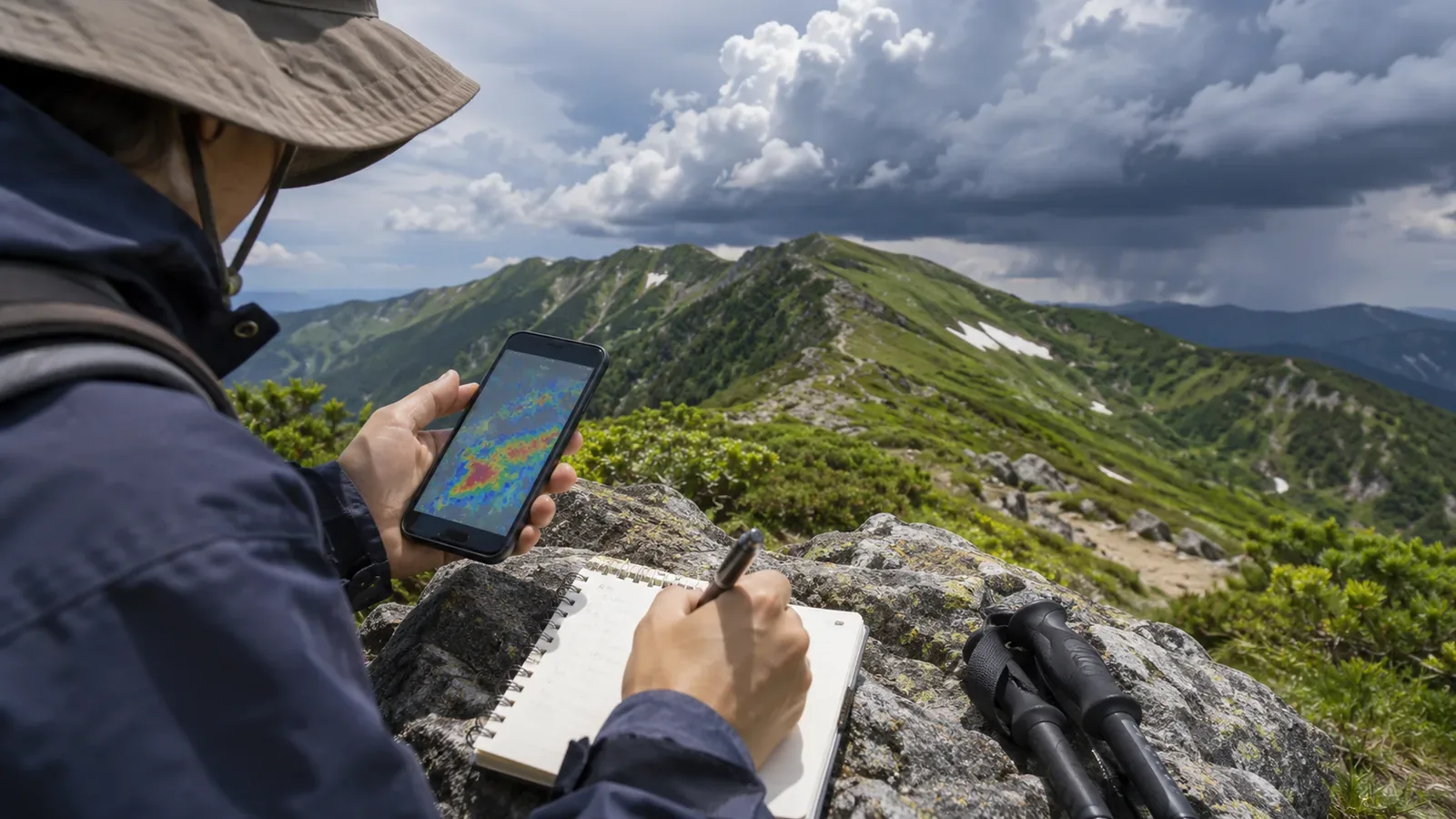
Compare the time you expect to reach the ridge with the weather forecast, thunder advisories and the Lightning Nowcast, and agree on a turnaround time before leaving. Guidance from the Japan Meteorological Agency (JMA) and other sources available as of October 27, 2026 identifies exposed high places such as summits and ridges as more prone to strikes on people. Waiting until you reach the ridge to check may be too late. Here is what each source can tell you and how we suggest using it in an itinerary.
Ridges leave little room to respond to lightning
The JMA explains that lightning can strike in many places, including mountains, and that people are more exposed on summits, ridges and open ground. The Society of Atmospheric Electricity of Japan also urges people to check the weather and be ready to cancel or postpone recreation at sea or in the mountains. Descending from a ridge still leaves you with the question of where to shelter. Check the route to a safe building or similar shelter and how long it takes before setting out.
A ridge is a difficult place to respond once you hear thunder. Compare your expected time of arrival on the ridge with the hours for which lightning is forecast while you can still change the plan.
Read forecasts and check thunder advisories the day before and that morning
Local weather offices in Japan issue forecasts at 05:00, 11:00 and 17:00 daily, with thunder advisories issued as needed. A forecast mentioning thunder or an outlook describing an unstable atmosphere signals possible lightning. Advisories are issued several hours before damage is expected. In its example for an outdoor activity from 14:00 to 16:00, the JMA suggests checking the previous day and that morning and planning how to respond if thunder is forecast.
Write down when you plan to reach and leave the ridge and compare the interval with the forecast and advisories. The timing of the weather and your hike can both vary. A small adjustment gives no assurance of safety. Consider cancelling, shortening the hike or choosing a different mountain. If you leave before 05:00, that morning’s regular forecast will not yet be out. Check any revised forecast, thunder advisory and the Lightning Nowcast available then, alongside the previous day’s 17:00 forecast.
What the Lightning Nowcast can and cannot show
The Lightning Nowcast analyses lightning intensity and potential on a 1 km grid, forecasts from 10 to 60 minutes ahead and updates every 10 minutes. It runs continuously, even without lightning. Its forecasts account for where storm clouds are moving and whether they are growing or weakening. Precipitation and tornado nowcasts cover separate phenomena. Open the Lightning Nowcast itself to check lightning.
At levels 2–4, cumulonimbus clouds are present and a strike can occur at any time. Seek shelter immediately inside a suitable building or another safe place. Level 1 means rain clouds may develop into thunderclouds. Plan for possible lightning within an hour. If shelter takes time to reach, start acting early at a thunder advisory or level 1.
Storm clouds can develop quickly in areas without a displayed level, and the monitoring network misses some discharges. If you hear thunder or see other signs of a storm approaching, seek shelter promptly.
If you will be on the ridge for more than an hour, the nowcast at the start cannot cover the full stretch. A shorter crossing can still carry risk. Where shelter is far away, decide using forecasts and advisories before level 1 appears. Allow for a failed update even where you expect coverage. If you lack enough information, leave open the option of staying off the mountain or avoiding the ridge.
Decide your turnaround time and shelter options on paper
Record the time you will spend on the ridge, junctions, the routes to possible shelters and the time needed to reach them. Plan chances to check the weather, remembering the ridge entrance may have no service. If lightning is forecast, discuss cancelling or spending the time somewhere safe. Agree that hearing thunder means promptly heading to the safe shelter you have checked. Avoid treating it as a signal simply to descend into the valley.
The Society of Atmospheric Electricity of Japan urges people to check weather information and be willing to change their plans, including cancelling, postponing or going home when needed during outdoor recreation at sea or in the mountains. Agree on criteria before leaving so you spend less time debating on the trail.
Check what a shelter offers before relying on its name. The inside of a reinforced concrete building or enclosed car is generally safer. Check the construction and access conditions of each hut or pavilion. Lightning can jump from a tree to a person beneath it, including in woodland. The JMA describes outdoor protective areas for emergencies when a safe space is inaccessible, and a nearby strike can still harm through the ground. Avoid relying on a fixed distance from a pole or tree and revisit your itinerary before entering areas where shelter is hard to reach.
Waiting times depend on the source and situation. The JMA says to wait at least 20 minutes after lightning activity stops before leaving an emergency outdoor protective area for a safe space. The Society of Atmospheric Electricity of Japan says a suspended outdoor event can resume after 30 minutes without further thunder. Neither passage sets a restart rule for hiking.
Set checks and a turnaround time before reaching the ridge
Compare the times you expect to reach and leave the ridge with the periods covered by forecasts and advisories. The Lightning Nowcast covers at most an hour and gives no guarantee for the route. Leave a margin and check the route and time to a safe shelter. If lightning is forecast, consider cancelling or shortening the hike. If you hear thunder or see other signs, act without waiting for the next update or scheduled time.
References and sources
- Japan Meteorological Agency, Using the Lightning Nowcast and its limitations
- Japan Meteorological Agency, What is the Lightning Nowcast?
- Japan Meteorological Agency, Protecting yourself from sudden heavy rain, lightning and tornadoes: Check weather information often
- Society of Atmospheric Electricity of Japan, How to protect your life from lightning
- Japan Meteorological Agency, Staying safe from lightning
- Japan Meteorological Agency, Using weather information issued in stages
- Japan Meteorological Agency, Weather forecasts