
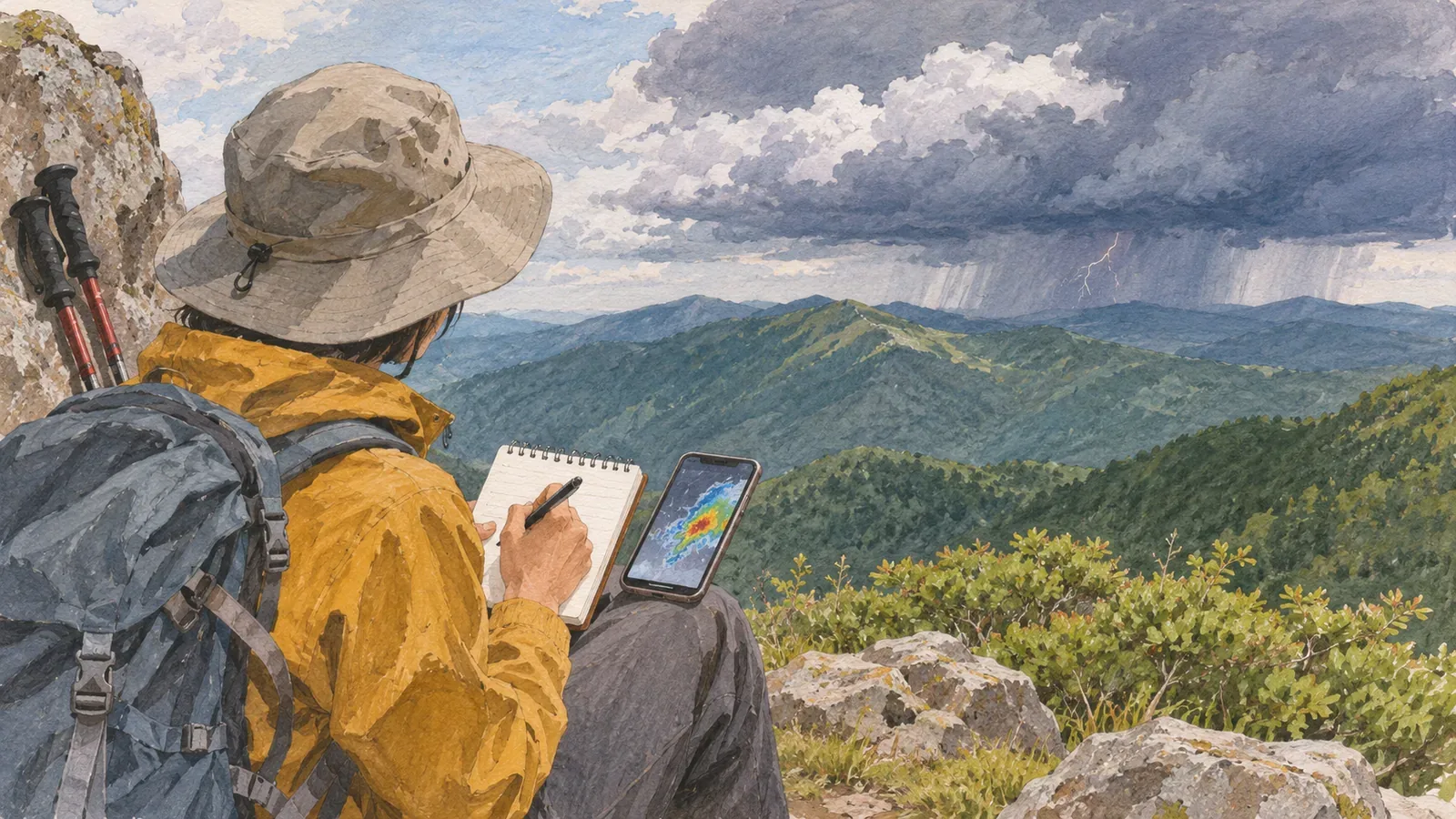
Even when thunder sounds distant, get to shelter before recording it. The Japan Meteorological Agency (JMA) treats audible thunder as a sign that a strike can be imminent and advises moving promptly to a safe place. Once inside a safe space, note when and where you heard it, what the sky looked like, what information you checked and what you did. There is no need to stay outside or use a device while moving just to get a record.
Make the record without delaying shelter
The JMA advises seeking shelter promptly if thunder or other signs indicate an approaching storm. Summits and ridges expose people to lightning. The Society of Atmospheric Electricity of Japan also recommends taking shelter in a building or vehicle. Lower ground still needs checking. Use your map and the route and footing you can identify, and avoid leaving the trail to descend into a ravine or stream bed.
Seek shelter before making notes, even if the thunder sounds far away. Avoid taking notes or photos while moving. Once safe, write what you remember. If you are unsure of the time, use an approximation such as “around 10:00” and mark that you wrote it later. The network misses some discharges, so keep what you heard separate from what the screen showed.
Record six things
These are our suggestions for applying the sources to a hiking log. First, note what you checked before leaving. Japan’s local weather offices issue forecasts at 05:00, 11:00 and 17:00 and issue thunder advisories as needed. Note whether the previous day’s or morning forecast mentioned thunder, whether the outlook described atmospheric instability, and whether a thunder advisory was in effect.
Second, note when you heard thunder. There is no need to check your watch before moving to shelter. Record an approximate time if necessary. Third, note the place, using a name or map position and whether it was a ridge, slope or wooded stretch. Fourth, describe the sound and sky. Was there one clap or several? Where did it seem to come from, and how were the clouds changing? Keep observations separate from interpretations. Sound alone cannot pinpoint the storm cloud or give an exact distance.
Fifth, record the Lightning Nowcast. If you checked it, note the activity level, analysis reference time, forecast valid time and time you opened it. Write “not checked” if you could not open it. A check with no activity shown is a separate result. Sixth, note what you did, where you sheltered, what you verified then and when you last heard thunder, as far as you remember. Avoid delaying shelter for a more precise record.
Compare the Lightning Nowcast with what you heard
The Lightning Nowcast analyses intensity and potential on a 1 km grid, forecasts 10 to 60 minutes ahead and updates every 10 minutes. Level 1 means rain clouds could become thunderstorms, so plan for possible lightning within an hour. At levels 2–4, cumulonimbus clouds are already present and a strike can occur at any time. Seek safe shelter immediately.
When reviewing, compare observations with information for the same area and valid time. Hearing thunder where your location showed no activity does not prove the system missed a discharge or forecast. Thunder from a different place, a mismatch in valid time and rapid storm development are all possible. Focus on whether you acted without waiting for the display and whether you left enough time to reach shelter.
The time you opened the display does not tell you how fresh the data were. You may have reopened a saved screen. Record the analysis and forecast times too. Precipitation and lightning nowcasts are separate products, so identify the one you consulted. Leave missing details blank rather than filling them with a newer screen.
Record each source’s waiting advice in its own context
The sources give different waiting times. The Society of Atmospheric Electricity of Japan says a suspended outdoor event may resume after 30 minutes without further thunder and advises checking current weather information for nearby storms before resuming. The JMA describes waiting at least 20 minutes after lightning activity stops before moving from an emergency outdoor protective area to a safe space. These are different situations.
Neither time automatically determines when a hike can resume. Check nearby storm clouds and conditions on the route, and consider calling off the hike. In your review, note the last thunder you heard and the information behind your decision. Outdoor emergency measures offer limited protection and a nearby strike can harm you through the ground. Avoid staying exposed to keep logging until a particular time has elapsed.
Practise on paper before the hike. Make a sheet with the six fields and fill it in from a memory of a weather change or an imagined scenario. Fields that are hard to fill, such as the time you checked the level or last heard thunder, show what is easy to overlook.
Use a record of distant thunder to improve the next decision
If you hear thunder, seek shelter before recording it. Once safe, note the information you checked before leaving, when and where you heard it, what it sounded like and how the sky looked, the lightning data and what you did. Record the analysis and forecast times separately from the time you opened the display. Mark uncertain memories. A brief record is best used to decide earlier whether to cancel or change the next hike. It is too limited to assess equipment accuracy or establish a safe waiting time.
References and sources
- Japan Meteorological Agency, Using the Lightning Nowcast and its limitations
- Japan Meteorological Agency, What is the Lightning Nowcast?
- Japan Meteorological Agency, Protecting yourself from sudden heavy rain, lightning and tornadoes: Check weather information often
- Society of Atmospheric Electricity of Japan, How to protect your life from lightning
- Japan Meteorological Agency, Staying safe from lightning
- Japan Meteorological Agency, Using weather information issued in stages